Τυφῶν | Typhoeus The betrayal of the ear

The pandemic from Covid 19 has brought to light a now undeniable conflict between the conception of humans as masters, colonizers, of the entire universe-which has marked Western culture for more than two millennia at least-and the principle of existence of Nature per se whose lawfulness prescinds from human presence, but of which humans are part among other species and among other kingdoms, living and nonliving.

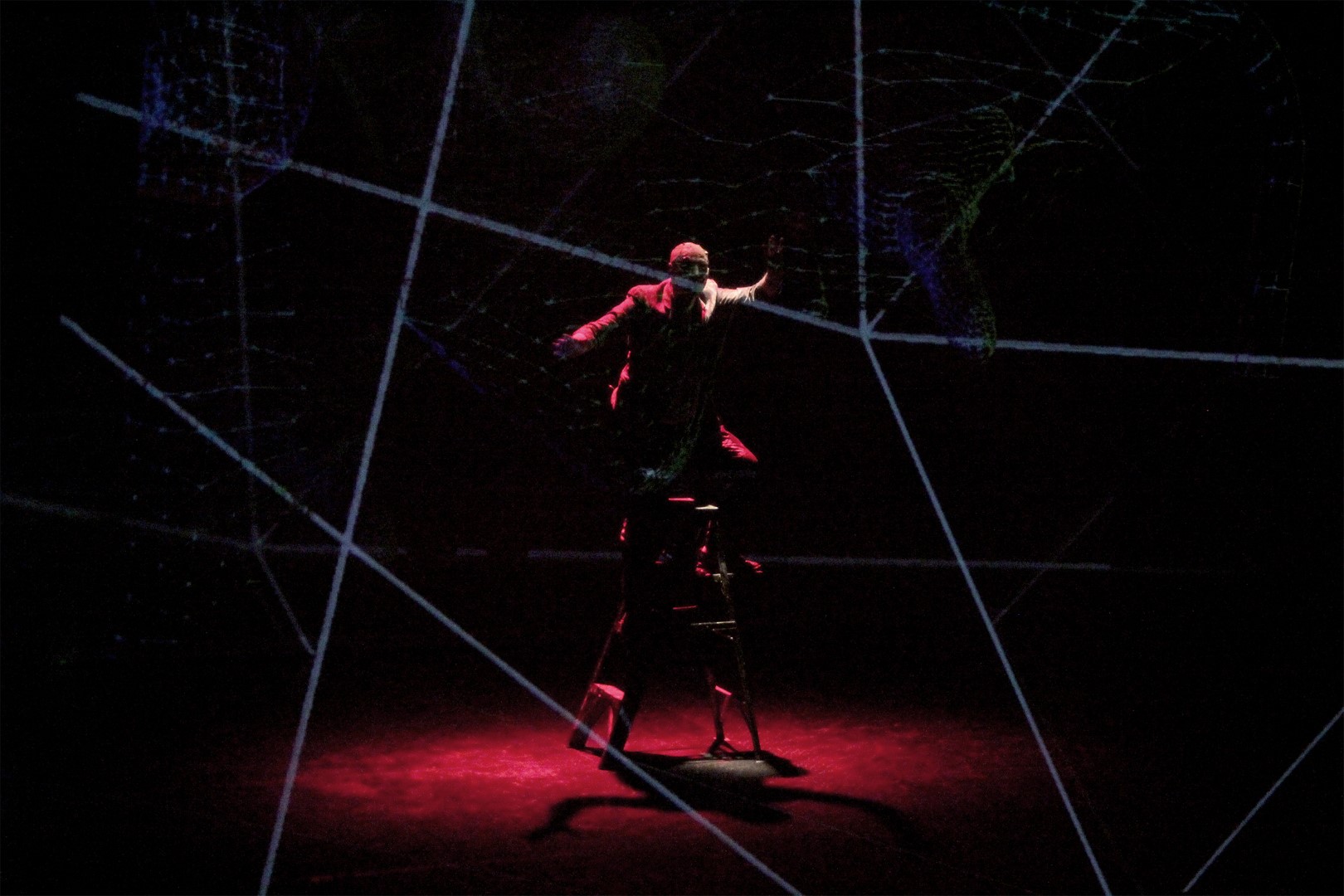
Retablo's performance stages a large virtual prison - translucent, technological and interactive - inside which is locked up Typhoeus, the monster with a hundred heads of ferocious beasts, with two hundred arms and two hundred legs made of tangled snakes that Zeus - in the mythological version - buried alive under Sicily, with his head crushed under the volcano. Repugnant, shapeless, telluric, Typhoeus is the symbol of an uncontrollable nature, hostile to man and civilization, to be corrected as erroneous, to be repaired, improved, fixed, healed. An outcast, cloaked under the reassuring superficial glittering crust of modernity and progress, the terrifying monster is treated, by the very rational Dr. Cadmus, as a psychiatric case, held outside the perceptual field of collective consciousness. Yet, though annihilated it continues to terrorize us. It returns like a regurgitation sowing chaos and terror and relentlessly destroying every human project.

Nature vs. civilization, body vs. machine, the human being is the outcome of this radicalization of extremes that come to touch. The augmented, polyphonic perception, the interaction between the human and digital elements, the externalization of senses through out-of-body devices, but less and less distinguishable from biological ones, create a new monstrosity. Like Typhoeus, the man of the technological age is imprisoned, detached from his own body, estranged from himself, but with the need to take possession of the same by asserting his own freedom/animality: the theater is the place where this happens.

Locked up in the back of his own mind, old Typhoeus can no longer instill terror by destabilizing the entire universe as he did in the days of the insurrection against Olympus, when he launched an assault on heaven and even managed to imprison Zeus. He continues to hear the voices of his hundred fierce beast heads, but his revolutionary vis has been disanimated by Dr. Cadmus who cures him by hypnotizing him with the music of progressive rationalism. His aim is to normalize the beast. He treats him as an error of nature, a psychiatric case.

As an extreme form of insubordination, Typhus, decides to voluntarily conform to the world's dominant culture, convinced that the end of his nature will be the end of the world's nature. His contemporary turmoil is all focused against Cadmus, who has deceived him into believing in his “promise of happiness,” in the sun of the future, in the conception of the world as a perfect machine, in the transformation of society into a perfect machine.
The monster's attempt to turn his anger into conformity fails miserably when, after yet another fable propounded to him by Cadmus, he is overcome by the primal impulse to revolt.

But on the outside of his mind, those who look at him see a misfit man defecating on the dining table and burning the sheets. So in the heart of his prison, the giant is unbowed, defeated by the ineffectiveness of his own actions. He rails against the doctor, guilty of having rushed to the rescue of the now annihilated and subdued Zeus and of having changed the fate of the universe of which Typhoeus had been crowned sole lord and master.

What observers outside his inner world see is a man who, in order to stop hearing the bewitching music of “magnificent fates and progressives,” cuts off an ear.

Typhoeus is the monster with a hundred heads of ferocious beasts, with two hundred arms and two hundred legs made of tangled snakes that Zeus saw fit to bury alive under Sicily, his head crushed under the volcano. Monstrous and formless, imprisoned, out of sight, out of the perception of consciousness, he returns like a regurgitation sowing chaos and terror and relentlessly destroying every human project.

It is the erasure of civilization, the reptilian outcast mind cloaked under the reassuring translucent surface crust that cloaks the horrid gorge of mad scare with modernity and progress.

“Modern philosophy begins with doubt, but eternal philosophy begins with terror,” Manlio Sgalambro reminds us. The terror of the world from which that terror originates, the terror that the world “is” regardless of our existence, the terror that the world doesn't give a damn about us and our agendas. However, along with terror, the world has been banished from progressive philosophy in an attempt to get rid of one through the other. We have been captivated by its promise of happiness: the sol de futir, the conception of the world as a perfect machine, the transformation of society into a perfect machine. We have committed ourselves and are committed to repairing, correcting, improving, fixing, restoring the wrong of the universe. We pledged and pledge to drive Typhus back into the darkness, to send him back to the backroom of the mind, to treat him as an error of nature, an error of human nature, a psychiatric case. Cadmus is the doctor, the astute one who has him in his care. He is the one who brought to the West the gift of the alphabet. He is the bearer of another way of being, of awareness, of thinking of an analogous self in an analogous space, of thinking oneself and the whole universe in a historical projection, of technological progress to fix the “wrong of nature, the wrong of Typhoeus.” Cadmus hypnotizes the monster with the music of “cogito ergo sum.” His goal is to normalize the beast. Typhoeus is enchanted by music. his Achilles' heel is his hearing, a priority sense of an earlier mental form. A form that had a developed auditory part called god and another part called man. More or less in these terms Julian Jaynes laid out his thesis in “The Collapse of the Bicameral Mind and the Origin of Consciousness.” God expressed himself with auditory predicates, and bicameral man heard them in much the same way that schizophrenics today report hearing voices from power outlets. Typhoeus is a reptilian part of the human mind, unable to plan for the future, totally absorbed in the here and now. He has no tools to protect himself from Cadmus' sham and falls into his faux-harmonic trap.

Credits

  • Ideation: Maria Piera Regoli, Turi Zinna, Giancarlo Trimarchi, Fabio Grasso

  • Dramaturgy and interpretation: Turi Zinna

  • Live music and sound engineering: Fabio Grasso and Giancarlo Trimarchi

  • Interactivity digital scene: Luca Pulvirenti

  • Lab: Mammasonica

  • In collaboration with: Piero Dauber (Hackspace)

  • Scenes: Salvo Pappalardo

  • Lighting design: Aldo Ciulla

  • Artistic supervision: Federico Magnano San Lio

  • Director: Turi Zinna

Video

For privacy reasons YouTube needs your permission to be loaded. For more details, please see our Privacy Policy.
I Accept