Staying nearby

to Turi Salemi
Loosely based on the short story of the same name
by Turi Salemi

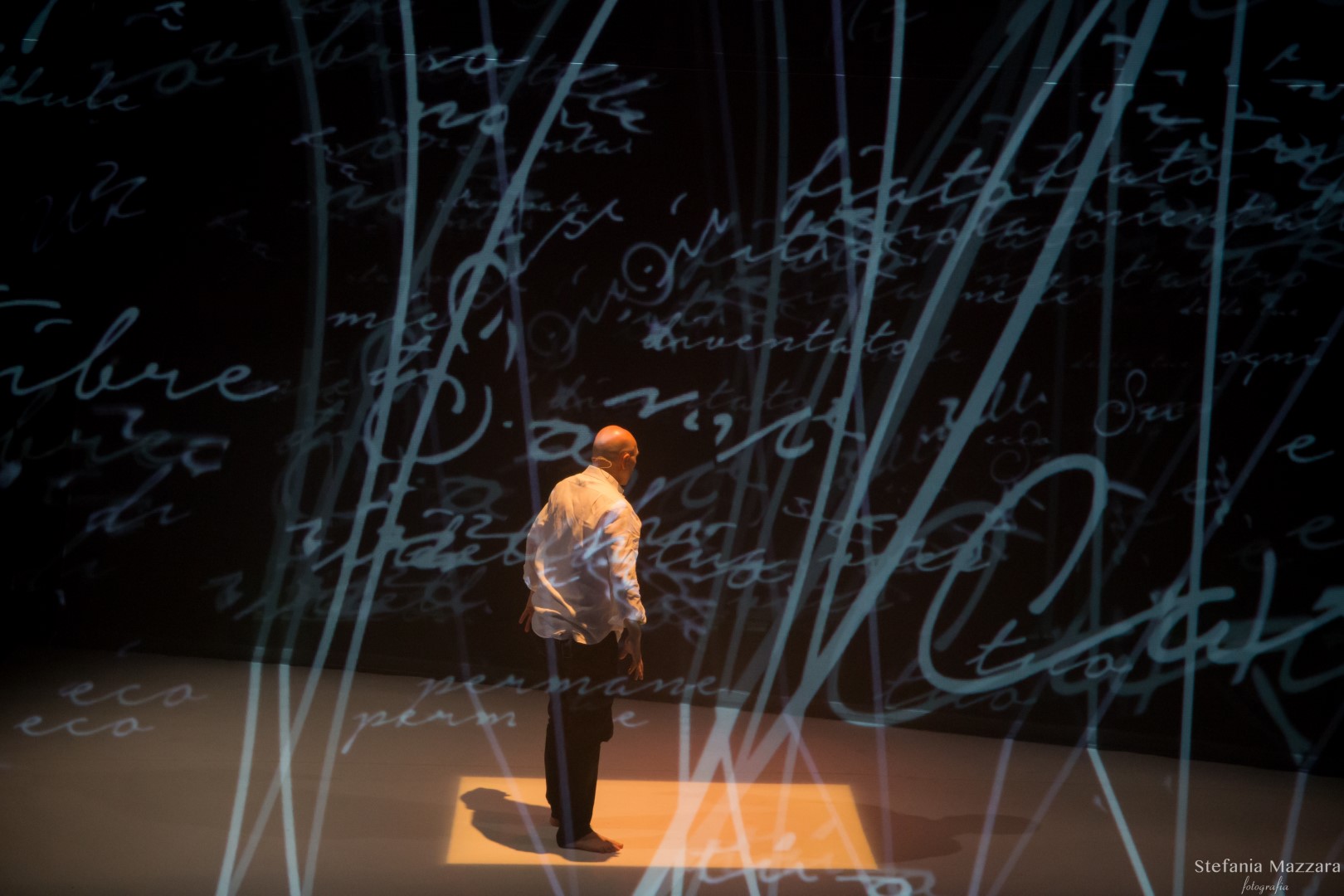
Self-enclosed in a clearing closet in the company of a rotting big toe and a crazy mirror, a man transmutes into a sheet of blotting paper. Remained imprinted on him, randomly and superimposed, are the letters, squiggles, echoes, and word shadows of a love affair never really lived. In an alternation of bursts into weeping and complex maneuvers of drying by proximity to a reddish bulb oscillating in arrhythmic jerks from the peeling ceiling, incited by André Breton's voice urging him to go all the way through his path of painful transfiguration, the poor sheet of paper towel falls apart until it schizophrenically splits into two parts.

In the cubbyhole, madness deflagrates. The furnishings come alive in imaginative figurations, while all around clatter huge wrecking balls that raze the entire neighborhood to the ground. When even the segregation closet remains demolished, the shattered shards of the paper man reassemble at the bottom of the iron ball that swings madly devastating walls, plots, towers, yards, chimneys, signs.

In the movement, the fibers of the sheet mutate into a final tear that detaches itself from the globe and goes to rest on the navel of the woman so much desired lying in the sun on the terrace opposite.

“Staying Nearby” is one of the very few published works by a legendary yet half-unknown figure of twentieth-century Catania literature, Turi Salemi. A poet. A jazzman of writing. a writer who has left almost no trace of himself. A Sicilian poet whom no literature remembers even in the margin notes. A composer of words who did not care to keep anything of his work. he wrote on improvised media, napkins, beer coasters, in a friend's dentist's notepad, the kind that is used for medical prescriptions, out of the blue, without even an erasure, without correcting anything. And he would even give his art away to people he had just met. he would lend out his poems and forget to ask for them back. He often lost them or burned them. An absolute talent who invented what had never been said and invented it at the very moment he said it. He was a firm believer that the act of poetry was a gift. He composed fully inspired as a verse charmer. He wrote in many languages. Most of his poetic output went scattered, as it had already fulfilled its task, the being declaimed at the time of writing it. His life was a rollercoaster of depressive phases and recoveries, admissions to asylums (where he was also given electric shocks) and relatively quiet periods.

A forgotten and unrecognized Catanese by the Catanese. A perfect symbol of Etnean impermanence. A creator dissipator destroyer, perfect metaphor of the genius loci of the territory of which he was a son. His work remained scattered, scattered, hidden, lost in the formless jumble of the stratifications of the city's memory. He died on Jan. 7, 1992, at the age of 60, when he was abandoned in the emergency room of Catania's “Garibaldi” psychiatric hospital due to pneumonia that was never treated. Those who, a few hours later, asked doctors for an explanation were told that there was nothing more to be done. But Gaetano Marcellino, his closest friend, discovered that Turi had been tied with straps to the bed, that to clean him up they had soaked him with a plastic tube, that the freezing water had debilitated his body, and that no doctor had taken care of him until it was time to sign the “statement of death.” He died as he had lived, Turi Salemi. As a bum, dispossessed, in the grip of a lucid madness that ruined his existence but gave him verses as sublime as they were unknown.

Credits

  • Concept: Maria Piera Regoli, Turi Zinna, Federico Magnano San Lio

  • Dramaturgy and interpretation: Turi Zinna

  • Live music and sound engineering: Fabio Grasso and Giancarlo Trimarchi

  • Interactivity digital scene: Luca Pulvirenti / Mammasonic workshop

  • Scenes: Salvo Pappalardo

  • Lighting design: Aldo Ciulla

  • Director: Federico Magnano San Lio